Why I built Trading Agent — and why one person, not a team
There are dozens of stock-prediction tools out there. Most are either gambler bait or expensive enough that nobody you know can afford them. Trading Agent is my attempt at something in the middle — built by one person, in New Zealand, on a laptop.
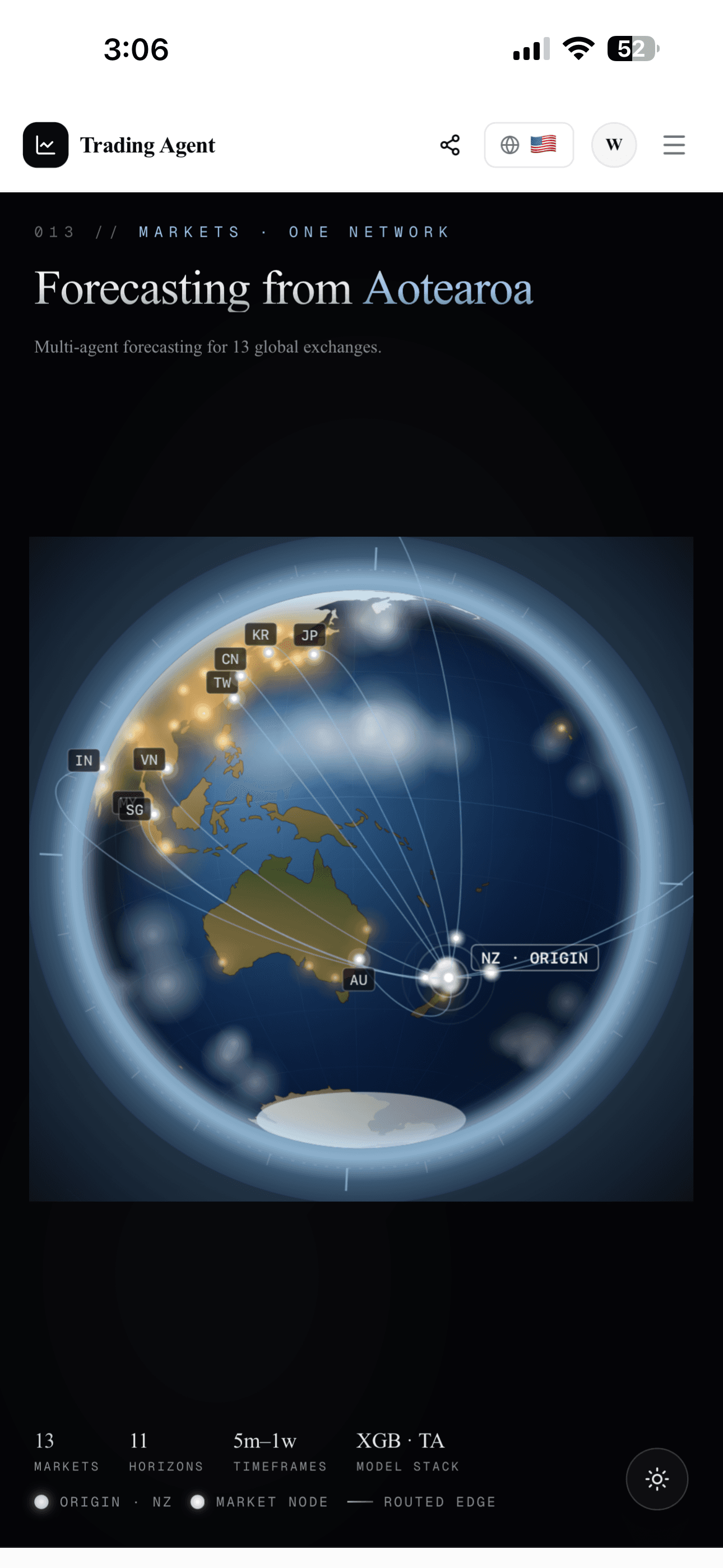
I'm William. I live in Auckland, New Zealand. I built Trading Agent over the last few years, on a laptop, alone.
This is a short post about why.
The two kinds of stock prediction tools I kept finding
When I started looking for tools to help me think about the market, everything I found seemed to fall into one of two buckets:
The gambling crowd. Free or near-free, full of bright colours and ★★★★★ ratings, promising you'll find the next 10x stock by next week. The numbers behind the predictions were either invisible or, when you dug in, obviously cherry-picked. The product itself was usually trying to sell you a Discord channel.
The institutional crowd. Bloomberg terminals at $25,000 a year. Quantopian-style platforms that were genuinely sophisticated but required you to write Python and have a CS degree to use. Sell-side research that retail can't actually access.
There wasn't much in the middle. Specifically, there wasn't much that was:
- Honest about what its models could and couldn't do
- Cheap enough that a normal person can try it without feeling robbed
- Transparent about the maths — methodology page, not "trust us, it's AI"
- Multi-market — most US-focused tools ignore Asian markets where a lot of retail money actually lives
So I started building the thing I wanted.
Why one person
A lot of fintech startups go straight from "idea" to "raise $2M and hire 8 people". I didn't want to do that for two reasons.
The first is honest. I came at this through a Bachelor's in International Business and Trade in Taiwan, and then a Master's in Business Analytics with a fintech specialisation at the University of Auckland Business School — so the cross-discipline mix is the degree on the wall, not a hobby. The methodology rigour (walk-forward, regime detection, position sizing) and the engineering (XGBoost pipeline, FastAPI backend, dashboard) both came from the analytics side; modern Business Analytics is half statistics and half Python, you can't avoid picking up either if you do it seriously. The multi-market coverage and trade-flow framing came from the international-business side. I find pitching to investors exhausting and tend to make worse decisions when I'm thinking about valuation than when I'm thinking about the product. Staying solo is partly self-knowledge — running a team is a different skill set from building one product really well, and I'd rather be honest about which one I'm currently doing better.
The second is structural. A small team has to grow fast or die. Growth pressure pushes you to make the kind of marketing claims I find embarrassing in this space — the "★★★★★ 90% accuracy" kind. If I'm not paying salaries, I can grow at the speed of what's actually true, not at the speed of whatever a VC needs to see next quarter.
Solo also forces ruthless prioritisation. There are maybe ten things on my to-do list that I think should be built. Right now I work on maybe two. The other eight wait. That's a feature, not a bug.
What Trading Agent actually does
In one sentence: it's a stock research tool — you give it a ticker, and it gives you the technical indicators (RSI, MACD, Bollinger Bands and friends), analytics from machine-learning models trained per market and validated walk-forward, and the models' complete, timestamped track record: every past call scored won or lost, misses included.
That's it. No alerts that say "BUY NOW", no AI personality that suggests trades, no email cadence designed to make you feel like you're missing out if you don't click.
What it isn't:
- It's not a robo-advisor. We don't pick stocks for you.
- It's not personalised. Everyone who looks at the same ticker sees the same thing.
- It's not magic. Machine-learning models get plenty of calls wrong, and how well they do varies a lot by market, by horizon, and by how wild the market is being that month. That's exactly why the track record is public: every call is logged before it resolves and scored after, so you can judge the evidence yourself instead of trusting one flattering number.
We currently cover 16 markets — US, Canada, UK, Japan, Korea, Taiwan, China, Hong Kong, Singapore, Malaysia, Vietnam, Indonesia, Thailand, Australia, New Zealand, India. People sometimes ask how I picked them, expecting a market-sizing spreadsheet. The honest answer is friendship: I have good friends in every one of those sixteen markets, and I built coverage for the markets the people I care about actually invest in. If I make good friends somewhere new, the map will probably grow. (Where the product is available and what it can show in each place is legal territory — the Disclaimer covers it properly, so I won't paraphrase it here.)
What this section of the site is for
I built this Insights section because I'd rather write one careful piece a week than send marketing emails. The goal is to talk through:
- How the methodology actually works (walk-forward, regime detection, factor analysis)
- What's going on in markets we cover — without telling you what to do about it
- Why I made specific product choices (why the app never tells you to buy or sell anything, for example)
- Mistakes I've made and what I learned
Nothing in this section is investment advice. It's a notebook. Whatever I write here represents how I'm thinking on the date stamped on the post — markets move, my views move, sometimes I'm wrong.
If you have something you'd like me to write about — a model question, a market, a comparison with another tool — there's a feedback channel for Quant-tier subscribers at /account/feedback. For everyone else, the contact email is in the footer.
— William
See the evidence for yourself — download the full resolved-prediction dataset, read the live public self-audit, inspect every model card, or run the research tools on your own data. No hype, just the receipts.
This post is the founder's personal note about Trading Agent. It is not financial advice and should not be taken as such. See our Disclaimer for the full statement.